
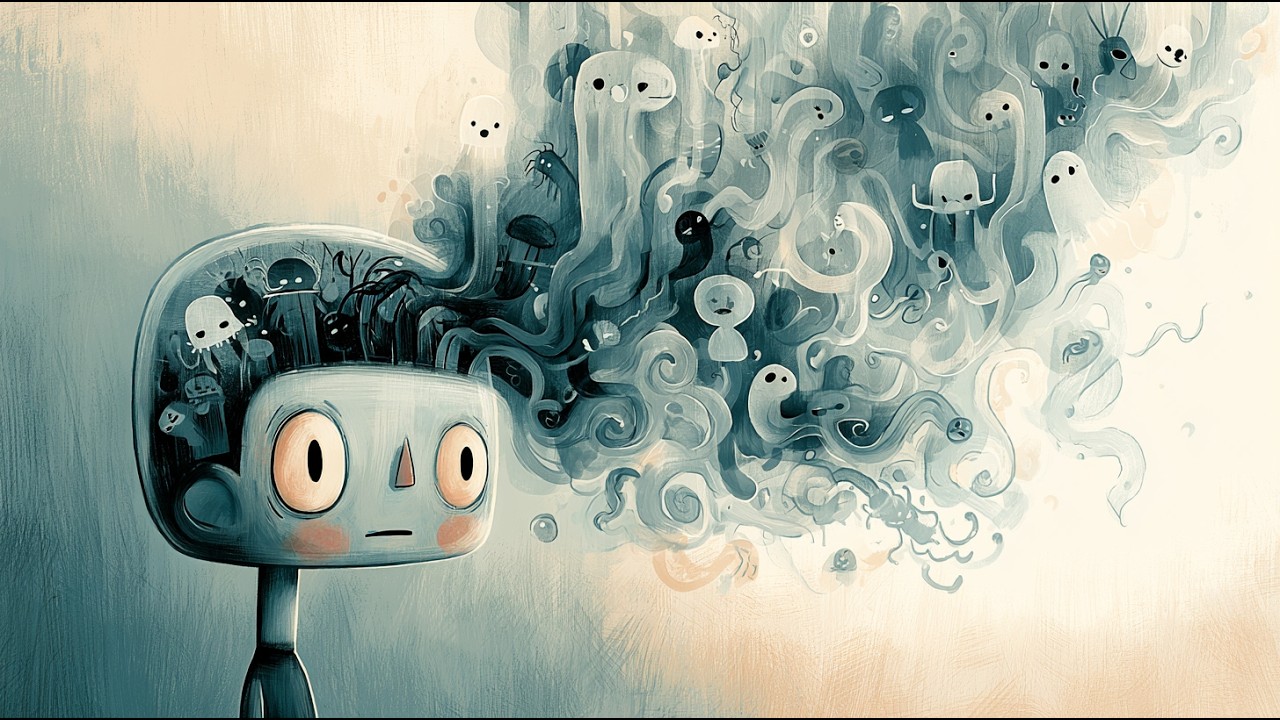
There comes a point for many people when they begin to notice something they may have overlooked for years. It’s not simply that certain thoughts are unpleasant. It’s that thinking itself can carry a subtle feeling of tension, contraction, or discomfort that seems to operate beneath the surface of everyday life.
This isn’t an argument against practical thinking or intelligence. It’s an invitation to look more closely at the relationship between awareness and thought. When that relationship isn’t examined, it can seem as though thinking is the only way to navigate life. But what if the very activity we rely on to solve our problems is also reinforcing the sense that we’re always living inside one?
This exploration of thoughts and mindfulness begins with a simple observation from childhood and unfolds into a deeper inquiry: What happens when thoughts are recognized as experiences rather than as our identity? And what becomes possible when attention returns to the quiet sense of simply being, already present before the next thought appears?
Do you find thoughts uncomfortable?
Many people do, although not everyone notices it. For some, however, there comes a point when the discomfort becomes impossible to ignore.
Before going further, I’d like to give a little context. I often speak about awakening as a process, and that perspective will naturally come into this discussion. But I want to approach this topic broadly enough that even if you’re not interested in spirituality or nonduality, there may still be something valuable here.
One of the earliest patterns I remember, beginning in late childhood and continuing into my teenage years, was noticing that thoughts were something I could become caught in.
There would be moments when I was simply playing, being present, or doing whatever children naturally do. Then, almost without warning, thoughts would begin to appear. Sometimes they came as images. Sometimes they appeared as an internal voice, almost like hearing my own narration.
Occasionally I could simply watch them. They were like a movie playing in the background.
Other times, something different happened.
Rather than observing the thoughts, I felt myself becoming entangled in them.
The closest metaphor I can offer is walking into shallow water and noticing strands of seaweed floating beneath the surface. At first they’re simply interesting. You become curious about how they move with the current.
Then, before you realize it, you’re tangled in them.
The harder you pull, the more trapped you become.
That was exactly how thoughts felt to me.

The More I Resisted, the Stronger They Became
Even as a child, I noticed something surprising.
The more I reacted to thoughts, resisted them, or tried to escape them, the more powerful they seemed to become. Whether they actually increased or whether my resistance simply amplified their effect didn’t matter. The experience was the same: pushing against thoughts made them feel stickier.
Part of this was probably natural development. As the brain matures, thinking becomes more sophisticated.
But there was something else happening at the same time.
Without realizing it, I was strengthening the influence thoughts had over my experience by constantly pushing against them or pulling toward them.
By “pushing and pulling,” I mean two different reactions.
Sometimes I tried to force myself out of thinking. I resisted the experience itself.
The irony was that I was resisting thoughts…with more thoughts.
I would mentally suppress them or create another layer of internal commentary about why I shouldn’t be thinking. Looking back, I would describe that experience as somewhat dissociative, although I didn’t have that language then. At the time, it simply felt as though I were pushing myself into a darker, more disconnected space.
At other times, I tried to think my way out of thinking.
I would analyze thoughts in order to solve the problem of thoughts.
It sounds circular now, but at the time it felt completely reasonable.
I’m genuinely curious how many people recognize this pattern. It seems common among the people I speak with, but I don’t know how universal it is. Perhaps you’ve noticed something similar in your own experience.
When Thinking Became My Identity
At some point, it felt as though I had become so entangled in the seaweed of thought that I was no longer someone caught in it.
I was made of it.
It’s as though I looked down and discovered that my own body had become seaweed too.
At that stage, the question was no longer how to get out of thought.
The assumption had already changed.
Now this inner world of thinking simply felt like where I lived.
From there, life became an attempt to improve that world.
How could I think better?
How could I organize my attention more effectively?
What could I do to finally make myself feel better?
Without realizing it, I had forgotten something essential.
I had forgotten that I was identifying with thought itself.
Instead of recognizing thoughts as experiences appearing within awareness, I was looking through the lens of thought and trying to understand both myself and the world from inside that lens.
As that happened, something else quietly faded.
The intimacy of simple presence.
That natural sense of being here, open, immediate, and connected to experience became increasingly obscured as attention became absorbed in planning, analyzing, worrying, and searching for solutions.
One problem led to another.
One imagined future replaced the next.
One strategy generated another strategy.
All the while, I failed to recognize that this entire landscape was being constructed out of thought.
The very medium I was using to escape discomfort had become the thing shaping my experience of reality.
It was almost like trying to extinguish a fire by pouring gasoline on it.
At the time, I couldn’t see any way out of that spell.
I eventually did discover one, and I speak about it often elsewhere. But during those years, something else wasn’t yet obvious to me.
Thought has a way of sustaining itself.
The more we search for solutions entirely within thought, the more we reinforce the feeling that there must be a problem needing to be solved.
Thought creates a kind of self-perpetuating loop.
No matter where you enter that loop, it continually encourages its own continuation.
From where I am now, looking back after that spell of identification was broken, this dynamic is remarkably clear.
What remains instead is a deep sense of peace.
Not because every circumstance is perfect, but because the constant cycle of imagined problems and imagined solutions no longer defines experience.
When I was identified with thought, there was never a lasting sense of okayness.
There was only the next problem to solve.
Or the next future to imagine.
Or the fantasy that peace would arrive once everything had finally been figured out.
Looking back, I can see that I wasn’t escaping the sense of a problem.
I was participating in the very loop that continually recreated it.

The Difference Between Life’s Challenges and Mental Problems
At this point, someone might naturally object:
“There really are problems in life. We have relationships to navigate, work to do, bills to pay, and difficult situations to face.”
Of course.
The important distinction isn’t between having challenges and pretending they don’t exist. The distinction is between life as it is and the mental version of life that thought continuously constructs.
This difference became increasingly clear to me.
There are life circumstances, situations, and challenges that require a response.
Then there are the psychological problems created through repetitive thinking.
Most of us assume that thinking is what solves life’s challenges. We believe that if we think hard enough, long enough, or cleverly enough, we’ll eventually arrive at the right solution.
But that isn’t what I found.
What actually responds to life is experience itself.
What responds is immersion in the immediacy of living.
A simple example illustrates this.
Suppose you’ve touched a hot stove once.
The next time you walk into the kitchen, you don’t need to repeat to yourself:
“Don’t touch the stove. Don’t touch the stove.”
You don’t avoid burning yourself because you’re constantly thinking about it.
Your body already knows.
The intelligence is already there.
The learning has happened.
There’s an innate responsiveness that doesn’t depend on conscious mental narration.
Without getting too mechanistic about it, this applies far more broadly than we usually recognize.
Relationship challenges.
Work challenges.
Creative decisions.
Planning.
Daily functioning.
Much of what we believe requires constant conscious thinking is actually carried out beneath the level of deliberate thought.
I don’t present this merely as an idea.
It’s how life functions now.
Once this becomes your direct experience, it begins to feel obvious.
Thought often claims responsibility for everything that happens.
But experience reveals something different.

Response Is Immediate. Thought Is Reflective.
The mind has another habit.
It turns everything into a problem.
Even listening to these words can become a problem if everything is viewed through the lens of solving.
It’s similar to the saying:
“If all you have is a hammer, everything looks like a nail.”
Thought functions much like that hammer.
It continually searches for something to fix.
Something to improve.
Something to worry about.
Something to solve.
Yet beneath that constant activity, there is another dimension of experience that has always been present.
There is a simple awareness that doesn’t think.
It is quiet.
Alert.
Conscious.
You could call it the simple sense of I am.
This isn’t something you create.
It’s already here.
It’s present for everyone.
Thought may become loud.
It may argue for its own importance.
It may insist that it alone keeps life functioning.
But underneath all of that noise, simple presence never disappears.
Notice something very ordinary.
When hunger appears, you naturally move toward food.
You don’t have to manufacture a chain of thoughts explaining why eating would be appropriate.
Life responds.
The organism responds.
Movement happens.
This kind of responsiveness unfolds continuously throughout the day.
You’re always responding to your environment.
Moving toward something.
Moving away from something.
Speaking.
Listening.
Adjusting.
Creating.
The process is seamless.
Thought, by comparison, is reflective.
It comments on experience after the fact.
Even more importantly, it often creates a subtle dissociation from immediate experience.
That distinction became increasingly important for me.
Life responds.
Thought reflects.
They’re not the same thing.
Is All Thinking Uncomfortable?
Once you begin noticing that thoughts carry a certain discomfort, another question naturally arises.
Is all thought uncomfortable?
Or only certain kinds of thought?
Looking back, I can see that my younger self sensed something important without fully understanding it.
I knew thinking felt uncomfortable.
But I didn’t yet recognize that I was identified with thought.
Instead, I assumed there must be something wrong with me.
Because the thoughts felt personal, they felt like me.
If the thoughts were disturbed, then I believed I must be disturbed.
If the thoughts judged me, then I believed those judgments were true.
The result was an almost constant feeling that something was fundamentally wrong.
There was shame.
Confusion.
Self-doubt.
Looking back now, it’s astonishingly clear.
Nothing was wrong.
There was only thought.
The discomfort wasn’t evidence of a defective self.
It came from mistaking thought for identity.
Even “Useful” Thinking Deserves Examination
At one time, I believed that some thinking was obviously helpful.
Planning.
Imagining positive futures.
Replaying difficult situations so I could avoid repeating mistakes.
Comforting myself with fantasy.
Those all seemed valuable.
Reasonable.
Necessary.
But experience eventually revealed something unexpected.
Even these forms of thinking turned out to be unnecessary.
In fact, I found almost the opposite.
When I’m not constantly replaying the past or rehearsing the future, there’s actually more clarity available in the present moment.
There’s more creativity.
More responsiveness.
Suppose someone believes they need to continually analyze past experiences so they won’t repeat them.
That wasn’t my experience.
I found that constant rumination actually increases the likelihood of repeating old patterns.
Thought conditions behavior.
The more repetitive thinking becomes, the more repetitive behavior often becomes as well.
Presence functions differently.
Without constantly referencing the past, there’s room for a fresh response.
Instead of reacting according to old mental patterns, there’s a spontaneous sensing into what’s appropriate now.
That responsiveness is often far more intelligent than the thinking mind gives it credit for.
Discovering That Thought Wasn’t a Mixed Bag
Before a significant shift occurred for me around the age of twenty-four, I still believed thought was a mixture.
Some thoughts seemed useful.
Others seemed harmful.
I assumed I simply needed to keep the good thoughts and eliminate the bad ones.
Eventually that assumption dissolved.
I no longer experienced thought as a mixed bag.
A single sentence helped illuminate this in a profound way.
I encountered it while reading The Three Pillars of Zen.
A Zen teacher wrote something remarkably simple:
“Thinking is the disease of the human mind.”
When I read those words, I was ready to hear them.
They landed with tremendous force.
Not because I adopted them as a philosophy.
Not because I wanted to believe them.
They resonated because they described something I had already begun to glimpse directly.
Obsessive thinking.
Compulsive analysis.
Fantasy.
Judgment.
Constant comparison.
Endless rumination.
These weren’t separate problems.
They were expressions of the same underlying habit.
The deeper issue was identification with thought itself.
That insight illuminated something fundamental.
Interestingly, I didn’t conclude that I should somehow stop thinking.
That wasn’t the message I received.
Instead, I recognized that the way I was relating to thought was creating tremendous suffering.
At the time, I didn’t yet realize it was the source of all psychological suffering.
That became clear later.
But I immediately recognized that something about my relationship with thinking had to change.
For the first time, I also sensed something profoundly hopeful.
It wasn’t merely a philosophical statement.
It felt like a direct transmission.
As though someone were saying:
Yes.
This is the source of suffering.
And you don’t have to continue living this way.
That possibility changed everything.