
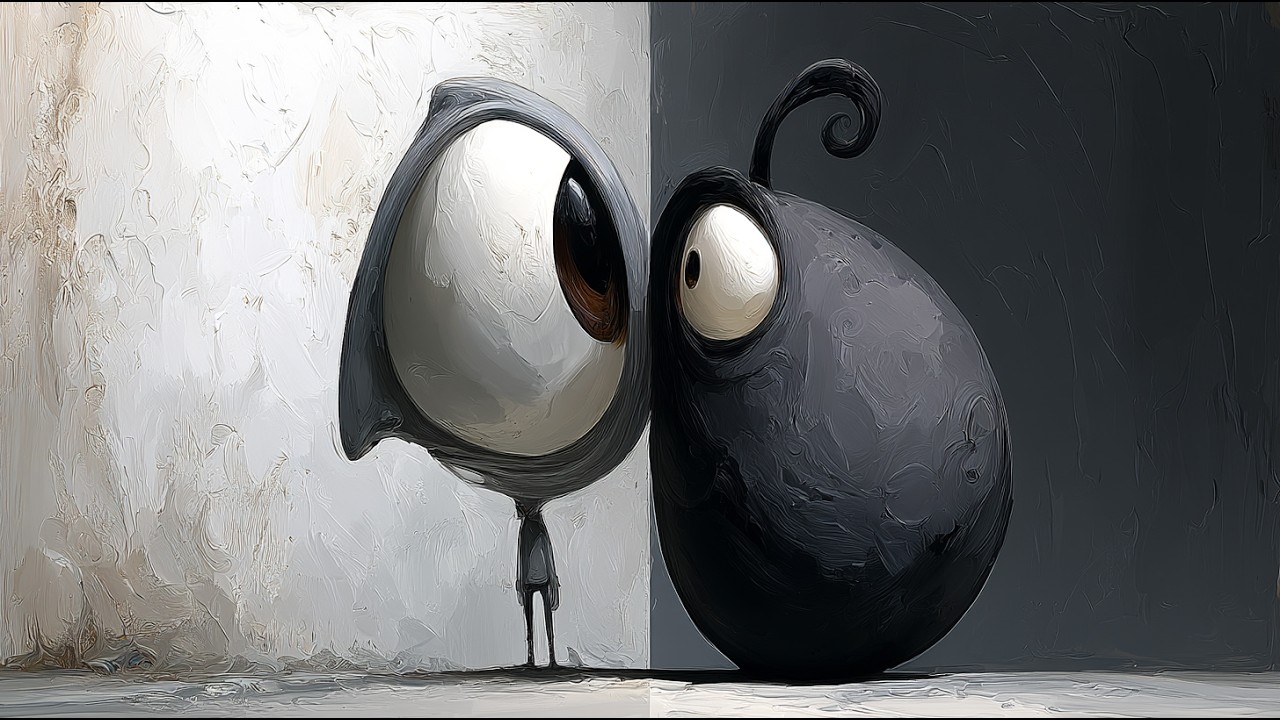
The subject-object construct can sound abstract until I look at it directly.
Then it becomes immediate: this subtle sense that I’m here, everything else is over there, and all of experience is arranged around a center called “me.”
This teaching is not asking you to believe that separation is an illusion. It’s asking you to test it.
Not by thinking. Not by philosophy. Not by neuroscience. By looking into the visual field, into labels, into distance, into the assumption that objects are “out there” and I am “back here.”
That’s where the spell starts to loosen.
What the Subject-Object Construct Is
When I start engaging the subject-object construct, confronting it, testing it, poking at it, I’m engaging the dualistic construct.
This is the function of the brain, the function of mind, that makes it appear as if everything is relational.
But not just relational in some vague way.
Everything is relational in the sense that all of experience appears to be in some kind of array around a center, around the subject, and in opposition to the subject.
“Opposition” doesn’t necessarily mean turmoil or conflict. It means that the very experience of having objects in reference to a subject makes it feel as if they’re standing apart from one another.
That gnawing sense of isolation that almost everybody probably suffers from until this spell breaks—that life of quiet desperation, that feeling of isolation we react to by endlessly seeking so many things, and even convincing ourselves we don’t feel it, and convincing others we don’t feel it—that’s what I’m confronting here.
That sense of isolation rises directly out of the polarity of everything being separate from me.
That’s a very isolated way to experience reality.
It’s inaccurate as well.
It isn’t actually that way.
But you can’t take my word for that.
Understanding Doesn’t Break the Spell
You can try to think about it.
You can try to understand it.
You can argue about it, philosophize about it, try to understand it through neuroscience, functional MRI, default mode network, and all of that.
You can try to learn about it all you want.
That doesn’t break the spell.
Not at all.
But you can break it.
You have to do it directly.
You have to directly confront the illusion of relationality, the illusion of self and other, the illusion of subject and object.

This Is the Most Empirical Thing There Is
So how do I do it?
Just like any assumption, I test to see whether that assumption is accurate.
And luckily, with this awakening work, everything is empirical.
Empirical means testable. It means I don’t make a conclusion until it’s discovered directly, in direct experience.
So this is actually the most empirical thing there is. It’s more empirical than much of what we consider science, because science is empirical when it’s done well, but it is also thought-based.
Here, I’m talking about what comes before thoughts in my own experience.
I can’t philosophize that.
There’s no model that’s going to get it for me.
I have to directly recognize it, realize it, clarify it.
Start With the Simple Feeling of Separation
From that standpoint, looking directly into experience right now:
Does it feel like I, as the body, or whatever I think I am—consciousness, or just the vague sense of “me,” however I identify—am separate from a painting on the wall?
But I have to look right now.
I can’t think about this.
If I’m thinking about this, then it’s pointless. I might as well just stop.
Maybe there’s not a painting near me. Maybe there’s a poster, a light, a window.
Does it feel obvious that that is apart from me?
Usually, the answer is: “Well, yeah, of course. I’m this body, and that’s over there. Of course they’re apart from one another.”
That’s where I start.
I start by being honest.
That I have that perception is fine.
Now: why?
Why do I have it?
What am I actually referencing right now when I say, “Yeah, I’m apart from that object over there”?
And then I notice what happens when I ask that.
I’m not going to give myself a right answer. There isn’t a correct sentence I’m trying to arrive at.
I have to look.
I have to really look and see: what am I referencing?

Do I Actually See Distance?
First, there are shapes, maybe.
Colors.
I guess there’s distance.
But where am I seeing distance?
I don’t see anything that says there’s distance here.
That’s a good start.
I see colors. I see forms.
But do I really see distance?
It’s easy to get into the mind very quickly here:
“Well, of course I see distance. When I’m driving, I don’t run into things.”
But those are thoughts.
I’ve already moved attention from direct visual experience into thought.
With this kind of work, it’s very important to understand that.
If I start thinking about this, attention is now in thought.
So I have to move it back out and just look into experience:
Why do I think there’s distance here?
What is indicating distance?
There’s a great quote by Emerson: “The clock indicates time. What does eternity indicate?”
So I could say: thought indicates space and distance.
But what does direct visual experience indicate?
Look, and keep looking without analyzing.
If I follow this inquiry—why do I think there’s distance here? What am I actually referencing in regard to distance?—hopefully I’ll see pretty quickly that I’m not referencing anything in the visual field.
I’m referencing thought.
That has to be seen directly. Otherwise thoughts will just confuse the whole thing.
Let Attention Flow Into the Visual Field
Everything along the lines of confronting the dualistic construct works like this.
I look.
I’m honest with my starting point.
“Okay, I’m in this room. There are objects there. There are objects around me. There’s distance and space. It seems like I’m definitely here. I feel a me here.”
That’s where I start.
Then I let attention flow into the visual experience itself, because that’s what I seemed to be referencing when I said, “There are objects, and there’s a me, and a body.”
Now I look.
I let attention go into the visual field and see through the pure experience of seeing.
I start asking questions that are actually interesting.
For instance:
“Okay, I have a body.”
What do I actually see?
I might say, “I see legs. I see hands.”
Maybe I’m looking in a mirror and I say, “I see a face.”
Great.
But what I’m describing are labels.

Can You See Without the Labels?
If I say, “I see hands,” I can notice:
I don’t see “hands.”
I see that.
I don’t see a hand.
I see that, and then I add a label.
But to add a label, I have to go into thought.
So I’ve already turned attention back into thought when I say it’s a hand.
Then what is that?
What is that without the label?
There’s a really great Zen koan: What is the sound of one hand?
It’s a beautiful koan. One of my favorite koans.
I didn’t do a ton of koans. I did some. Mu, of course, though I’d already woken up, so Mu wasn’t a breakthrough koan for me.
But “what is the sound of one hand?” is wonderful.
In a sense, it’s addressing this, although I wouldn’t say that koan necessarily breaks the construct by itself. This construct is tenacious. I really have to dig in.
But it does address this in a beautiful way.
So again, I see this, and I say, “It’s a hand.”
And then I ask:
When I was 12 months old, and someone held this up, what did I see then?
A hand?
What about when I was 6 months old?
Certainly I didn’t have a word for hand.
Did I see a hand?
What did I see there?
I saw that.
I definitely saw it.
And I see it right now.
Can I see it without the label?
Can I see everything without the labels?
That’s how this works.
Where Does Objectness Come From?
So I question myself:
If all these objects have names and labels, and I can see what I’m calling objects, and I can also see that I don’t actually have to put labels there, then how do I know they’re objects?
Where is the objectness coming from?
Why do I think there are objects?
Objects meaning anything but me.
If I look closely, I’ll usually see there’s no reason for that in the actual experience.
But mind will bounce back and say, “Well, because I’m here seeing those objects.”
That’s relational.
The possibility of objects depends on a relational experience.
It depends on the sense that there’s someone back here inside, apart from everything, with everything in an array around it, while that someone is the center of everything.
And that is also a bag of assumptions.
Look for it.
Look for Objects, Look for Self, Look for Space
I can look for the objects.
I can look for the self.
I can look into visual seeing and see where the idea of space comes in.
All of these are assumptions.
I know they’re assumptions very quickly when I reference my thoughts about seeing, the visual field, the world, me and others, subject and object.
All of that is thought.
And I can question any of those assumptions.
There are many assumptions baked into describing myself as a distinct entity, others as distinct entities, objects as separate from me, and me as the center of experience.
No matter which way I turn my head, it seems like I’m still at the center and I’m seeing things arranged around me.
But without all those labels, what is really happening there?
Is there a head turning?
Conventionally, this sounds goofy.
Experientially, it’s pretty radical when it shifts.
It’s pretty cool.
Three Practical Keys for This Inquiry
These are the kinds of approaches I suggest.
Do it the way it works for you.
But there are a few important things.
First: don’t do it conceptually. That’s not going to work. You have to go to the experience.
Second: question the assumptions.
Third: enjoy yourself. Relax. Have fun. Become curious.
You have to have curiosity, or nothing is going to happen here.
Use that curiosity.
But be a little bit stubborn about not settling for thoughts, labels, conclusions, or terminology, because all of that is in the head. It’s all in thought.
You won’t see it if you settle there.
This isn’t rocket science, but it does take precision and a little bit of tenacity.
And it does take earlier awakenings before this will be easy to grok.
It would be very difficult to grok if I’m still mind-identified, because everything is a concept. Everything is a thought. Everything is a belief.
Thought, thought, thought, thought, thought.
Once that spell breaks through mindfulness, through meditation, and especially through awakening, and I start to experience more directly, then I can question the assumptions that I overlay onto what is directly perceived.
And I start to see how deep this rabbit hole really goes.
It goes rather deep.