
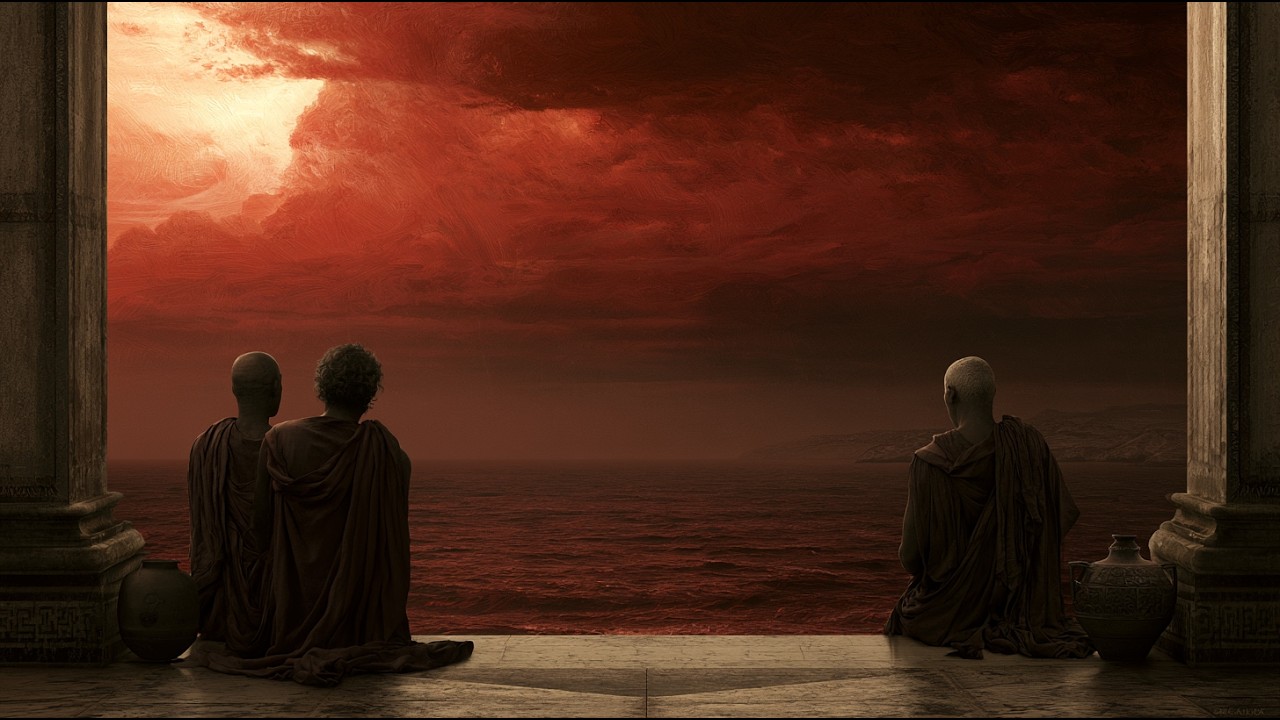
Do you ever wonder how much of what you call “seeing” is actually the mind finishing the picture?
We assume perception is straightforward: light hits the eye, the brain reports reality. But there’s another layer—top-down processing—where what I’ve learned to name becomes what I’m convinced I’m seeing.
That matters for awakening. Because the subject-object construct isn’t just a philosophy. It’s a perceptual filter that can dissolve. And when it dissolves, it can feel as obvious as a color you can’t unsee once you’ve learned it.
Did the Ancients See Blue?
Do you know that the ancients didn’t see blue?
They didn’t see the color blue. They didn’t perceive it.
You might be thinking, “Well, of course they saw the sky and they saw the ocean,” and they did. They wrote about seeing the sky and the ocean. They had names for them, terms for them, but they didn’t have a term for blue, with a notable exception.
This was first recognized by a British prime minister named William Gladstone in 1858. He noticed while reading Homer’s Iliad and Odyssey that the word blue is never used. But the words black, white, red, green, yellow—these words were used. Homer would refer to the ocean as “wine-dark,” but not blue.
[Possible clarification needed: this historical/timeline claim is presented as research summary in the transcript and may need verification of sources and dates.]
And it wasn’t until, I think, the 1960s that a couple of philologists or linguists characterized this, studied it, and formalized it by looking at ancient languages and seeing when blue—the concept of blue—was formulated in language.
They found that almost across the board, with one notable exception (Egypt), somewhere around 2500 to 2000 to 1500 BCE, writings from ancient China, the Old Testament, the Greeks—these cultures didn’t have terms for blue. They would refer to things we call blue in other ways: dark, black, or descriptors that weren’t necessarily colors.
The exception is Egypt, which had a word for blue as early as 2500 BCE.
In these other cultures, the word for blue didn’t seem to start to appear until around 500 to 600 BCE. So for roughly a 1500-year period, we have writing describing other colors but not blue—then suddenly we see blue appearing.
One theory is that until humans were able to make a dye that was blue, we didn’t have a word for it. That’s one reason that theory exists: in ancient Egypt, they had a blue dye, and then they used the term for that dye as blue, and used it to describe other “blue” objects as well.
A Modern Example: When Blue Looks Like Green
There’s a really interesting modern example.
There’s a tribe of people in Namibia who don’t distinguish blue from green in the way we do. If you show them a palette where there are several greens and one blue, they often have trouble picking out the blue as different. It can look like shades of green.
If you point out, “This is blue,” and show it as a different color, then they start to see the distinction. But before it’s pointed out, they often won’t.
At the same time, that same group has a very complex system of naming shades of green, such that Westerners looking at that palette can’t distinguish certain greens that they easily can. To us it’s “just green.” To them, it isn’t.

Bottom-Up and Top-Down Processing
The reason I’m driving deep on this is that there’s both bottom-up and top-down processing in the visual cortex and how we perceive the world: objects, colors, and so forth.
And this has a correlation to awakening—very much so.
It correlates especially when we start looking into the subject-object construct and non-dual perceptual filters. This is exactly what you’re starting to challenge.
This “color” example is a paradigm you can use to get a feel for what I mean when I say the subject-object construct is added on, even though it seems so obvious.
To someone in Namibia, it might seem obvious that a certain shade of green is different. To us it looks the same. To them, blue looks like green. To us it’s “obviously blue.”
When the veil drops—when the subject-object construct drops, the sense of being “me back here” and “a world out there” divided up—then it’s obvious.
But before it drops, it doesn’t look that way. You can’t see it, because the filter is doing its job.
And here’s the interesting reversal: in the color example, it’s like something you didn’t see and then you see. With subject-object, it’s almost the opposite. It’s something you think you’re seeing, and then all of a sudden you don’t see it.
But the processing is similar.
Once your brain learns a label—or believes a label—it exaggerates contrast. It adds sharper edges. It adds what isn’t actually there. Optical illusions work because they exploit this.
So it’s similar with subject-object.
You think you’re seeing self and other.
You think you’re seeing a world of dimension and separation.
But all of that is added in.
Those are labels you learned.
Labeling and the Third Aggregate
In Buddhism there’s the paradigm of the five skandhas, the five aggregates. This third aggregate is essentially labeling.
It’s when something becomes an object. It becomes a that. It becomes a thing.
It becomes a lamp. A poster. A body.
And we think, “Oh, that’s just us learning to label objects in the world.”
But do you remember when you started labeling objects?
Do you remember being less than 18 months old, learning labels?
You don’t remember it, because memory wasn’t functioning the way it does now.
So it can seem absurd that we didn’t see things before we learned to label things.
Of course we saw. But we didn’t see objects.
We didn’t see a subject-object construct.
We didn’t see dimension.
We didn’t see “world.”
We didn’t see blue, red, yellow, green, black, white.
We didn’t see dog, cat, mom, dad, self, me, you.
We didn’t see that stuff.
It’s this ocean of visual experience without the label “ocean,” without the label “visual experience.” We didn’t even know it was visual.
But it was there. It’s here.
Non-Duality as Experience Without Labels
So you actually regain that.
You regain that totality of absorbed experience without labels.
It’s here.
This is the experience of non-duality. It really is.
And the beauty of it is: when those perceptual filters are broken—when the spell breaks at the level of identity, because that’s what holds all this together—then something fascinating happens.
It’s not like you can’t function in the world.
You can still see something as an apparent object.
You can still say “me.”
Someone calls your name in a room and you can raise your hand. You know they’re talking about you.
But there’s nothing behind it.
There’s no one in there experiencing that.
It’s just happening.
It’s all spontaneous.
And when I say “you know that,” there isn’t really a you that knows it. There isn’t a you.
There’s recognition. There’s sound. There’s sensation. There’s response.
But it’s all just happening in this total ocean of experience that’s non-dualistic, that has no labels.

The Scaffolding: How a World Gets Built
This example about color is fascinating, but it points to something even more important.
At a fundamental level, when we learn to label things, we add a lot more to reality than is actually there.
We build perceptions.
It’s like there’s a framework of perception and we build onto that until this world of thought identification feels real.
And at some point it catches up with us. It overtakes us. It feels uncomfortable.
This is dukkha. This is unsatisfactoriness.
This is what starts to wake you up.
This whole thing is beautifully orchestrated in some sense.
All of that scaffolding is built on a foundation of self—this subtle fundamental filter: self, self-and-other self.
It’s a filter that allows the scaffolding of objects, that, this, color, shape, form, separation, movement, causality, time, space.
So the point I want to make is: all these things I talk about—subject-object dropping away, sense of form dropping away—you see those are illusions.
And then the most subtle filter that allows any of those illusions to stand at all drops away itself.
Then it’s this world—it’s not a world—but the world of freedom.
A world of freedom, spontaneity, wonder.
The constraints of the perceptions themselves: you’re free of the constraining nature of them, but the perceptual operators still work. You still function through them in a relative world.
And it’s not a problem.
You can actually enjoy it now.
Nothing feels off.
Nothing feels heavy.
There’s no one to solve the problem of me anymore. It’s drained out of the system.