
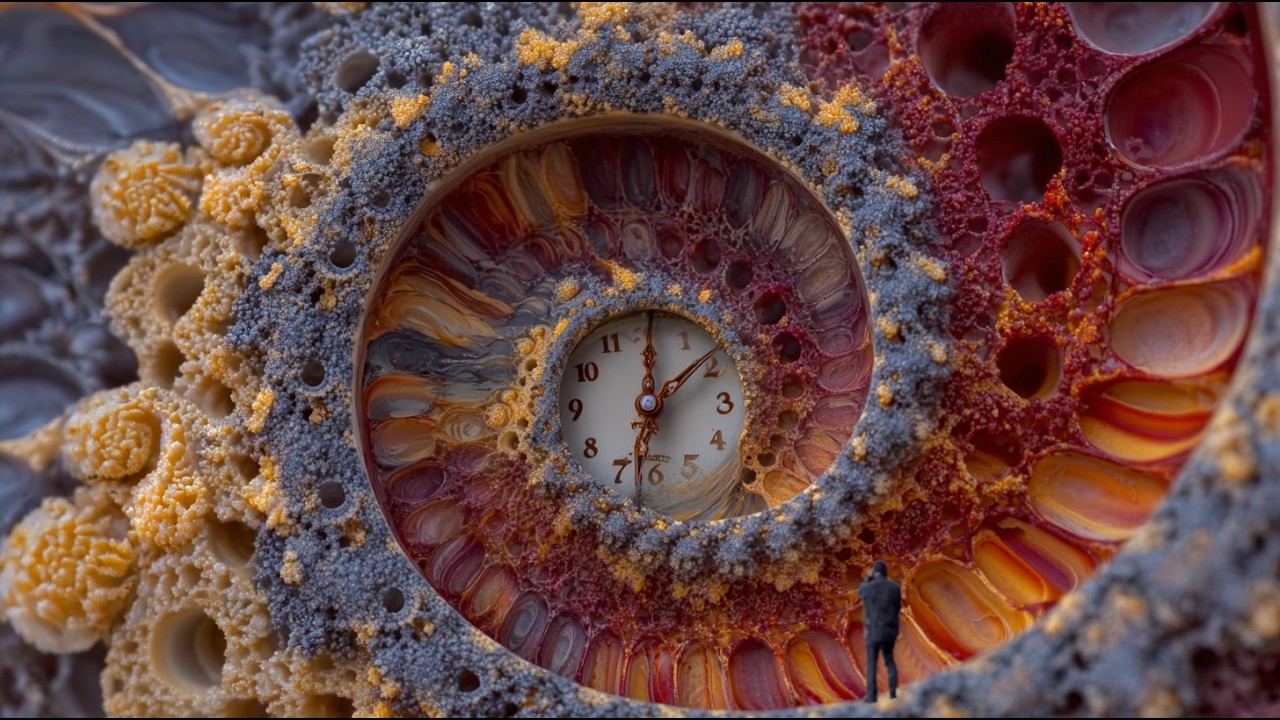
Many people taste timelessness and feel a real release—like the mind loosened its grip on the past and the future.
And then, strangely, they find themselves caught again.
Not because the insight was false, but because something subtler remains: a sense that someone is still here to be “in or out of time,” to check in on how things are going, to keep the self consistent, to correct what happened earlier.
This talk names that subtle residue directly. The speaker calls it perpetuity—the felt illusion that there is something continuous that can move through time, even after time is seen as thought.
And he points to what happens when that illusion breaks: a deeper freedom than timelessness alone.
Time as Thought, and the Playlist That Points to It
As important as seeing that time is an illusion—and if you want to look into that more, check out my playlist called “Time and Eternity,” I think, where I point to this very directly, which I won’t do in this video—past and future are always thoughts.
You’ve never experienced the past or the future.
As important as seeing that is, it’s equally important—or maybe when the realization of timelessness or eternity matures, the other side becomes more important.
Beyond Time: The Illusion of Perpetuity
What is also an illusion is—I’m just going to use the word perpetuity.
It’s a big word, kind of goofy, but it’s what’s coming.
In the conventional way of thinking, there’s something moving through time. There’s time through which something can move: you, objects, events.
It’s not only that the time part is inaccurate.
It’s that there is anything that can remain consistent to move through time.
That’s the perpetuity I’m talking about.
Timelessness Can Be a Real Relief—and Still Not the End
The feeling you get when you touch into the eternal—which can be a kind of mystical experience, like the kind of experience you might get listening to these videos where I point to time being a thought—can afford a bit of freedom.
A feeling of release.
But usually there’s still something there that reifies itself.
Not always, but usually.
Something still reifies itself, and that’s why you keep getting caught back in the sense of time.
Because that sense of perpetuity is still there—this sense of something constant, something continuing.
When Perpetuity Breaks: No One to Maintain
There’s something in perpetuity that feels like it is the one that’s either in or out of time.
But when that one breaks—when the illusion of perpetuity breaks—that’s a deep, deep freedom.
A visceral freedom. Energetic freedom.
Not only is there no time, there’s no way to suffer from the illusion of time.
There’s nothing that has to be preserved within time.
There’s nothing that has to be kept consistent over time.
There’s nothing that can check back in with itself to see how it’s doing.
There’s nothing that needs to be corrected in regard to itself in the past, itself in the present, and itself in the future.
There’s nothing subject to that correction.
There’s nothing subject to using time as a reflection back onto itself to keep itself in alignment—in perpetuity.
That’s part of it.

The “Fixing” Impulse and the Core Assumption
The other part is the impulse to fix itself—trying to fix something, trying to correct the fundamental issue.
But the fundamental issue is always centered on the illusion of the one in perpetuity: the one that can move through time, that has a past and a future.
Why This Is More Obscure Than Timelessness
So hopefully that lands.
It’s a little obscure—more obscure than talking about timelessness or eternity—because you can look outward to thoughts and prove to yourself again and again that time is thought-based.
But this is almost like looking inward and seeing that this is also thought-based.
It’s like a shadow of time.
It’s almost like the shadow cast by constant thoughts about time or constant belief in time casts a shadow that we backward-extrapolate into a self.
Into the one in perpetuity: the one moving through, the one that has to maintain itself, protect itself, defend itself, correct itself.
That’s what it is.
Like an accumulated shadow or residue, perhaps.
And seeing that that itself is also not there.
Then… (language gets goofy here, and the speaker acknowledges that) in conventional terms, as you move through your day, through your environment, there’s not only timelessness.
There’s total freedom from the one that has to continue to exist in a certain way or correct the way it exists.
That’s just not there.
Mere Appearance Without Karmic Handcuffs
So it’s like appearance, appearance, appearance, but they’re not connected to one another.
They’re not chained together with karmic handcuffs that require repair, that require maintenance at all.
That’s where the real freedom is.
It’s the freedom of mere appearance that doesn’t have anything to do with time or self.
It just has to do with what it is: clear, empty, pristine, intimate, and clear.
And spontaneous.