
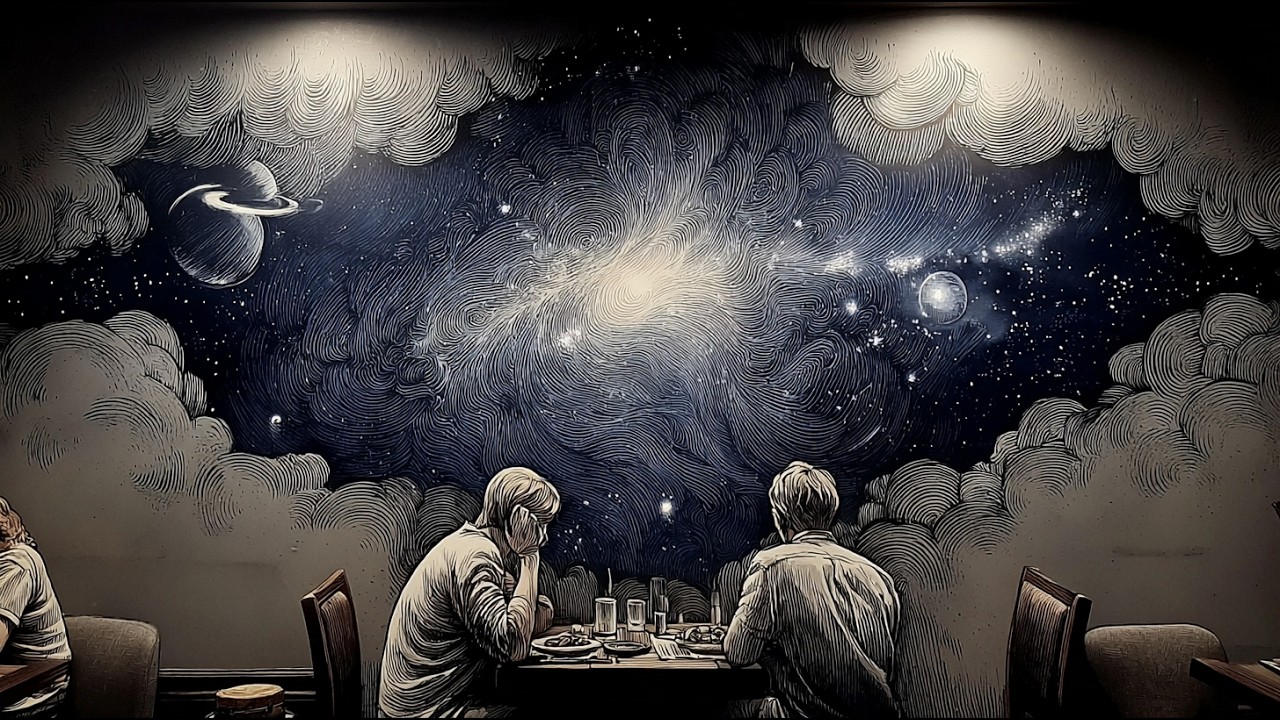
A lot of sincere seekers are doing something that feels responsible: trying to understand awakening, trying to aim at it, trying to make sure they’re doing it “right.”
But the speaker’s claim here is blunt: that approach is the very thing that keeps you from tasting what you’re looking for.
Because the mind doesn’t just hold ideas about awakening. It identifies with them. It uses them like a menu—describing flavors, comparing options, imagining outcomes—while the actual meal sits untouched.
This talk is a direct invitation to notice that habit, and to see what happens when the menu finally drops.
Awakening Isn’t Making Something Happen
Awakening is not about causing what you think awakening is to happen.
Awakening is not about making your experience or your reality look like what you think awakening is, or what you believe awakening is.
Awakening is not about understanding what awakening is.
I know that may sound like a contradiction, but it isn’t.
Understanding what awakening is is not what awakening means when I say the word awakening. It’s not what I’m pointing to.
The Menu Isn’t the Meal
In the same way that if I point to eating the food, I’m not saying, “Look at the menu.”
What’s worse with awakening is: the menu is not even the right menu for the food.
The menu is your menu. The menu is your mind’s idea.
So the analogy—“to taste the food, you have to taste the food, reading the menu won’t satisfy you”—doesn’t even get to the heart of the matter.
The heart of the matter is: your menu is inaccurate.
You Think You’re Ordering a Hamburger—But Something Else Is Already Served
So you’re reading the menu and you think you’re going to eat a hamburger.
But what’s served is something totally different—and it’s already been served.
It’s already on the table.
You just don’t notice it because you’re looking for the wrong thing.
So maybe you’re expecting hamburger, but what’s on the table is prime rib—whatever.
There’s a different dish on the table and it’s already there, already available.
But you’re not tasting it.
You’re not seeing it.
You’re not appreciating it.
You’re not noticing it because you have the menu in front of your face and you think you’re going to find the hamburger.
So you’re looking for the hamburger in the menu, not looking at what’s right in front of your face on the table.

The Gap Moment: Putting the Menu Down and Picking It Right Back Up
And if you happen to drop the menu for a minute because someone says, “Look past your thoughts, look into the gap,” what happens is you drop the menu—but you don’t think it’s there, because you’re still expecting it to be what you thought it was.
So then you put the menu back up.
That’s my restaurant analogy for awakening.
It’s one of the questions that comes up frequently, and one of the comments I get frequently.
People get confused when I say you don’t have to think about awakening.
You don’t have to make a goal out of awakening.
You don’t have to know what awakening is.
You don’t have to understand what I’m talking about when I say awakening.
None of that has to happen for you to wake up.
I know that’s confusing for some people, and frustrating for some people, but it’s true.
I’m not being cute. I’m not trying to be slippery or evasive.
I’m literally telling you how it is because it’s like the menu thing.
Bad News to the Mind, Not Bad News to You
If you really let this message land, it’s not bad news.
It’s bad news to your mind.
It’s bad news to the part of you that says, “No, I want my menu to be right. I want my menu to be right. I want to get out of awakening what I want to get out of it.”
“I don’t want to believe you fully when you say it doesn’t give you what you think it’s going to give you.”
That’s not my problem. That’s your problem, if that makes sense.
I can’t fix that for you, but you can look at it and see: maybe it’s true that what I’m saying is accurate—that I’m not going to get out of awakening what I think I’m going to get out of it.
And the reason is important: what you’re identifying with is the menu itself.
You’re not just reading the menu. You’re identifying with the menu.
There’s something that doesn’t want to put the menu down, or doesn’t want to stop believing in the menu.

When the Menu Becomes Unsatisfying
At some point, you realize the menu itself is unsatisfying.
Reading the menu over and over, knowing it really well, talking to other people who have menus, comparing notes about what you think awakening is with other people…
Most people who watch my channel don’t do this, but there are online places—forums—where that’s exactly what people do.
It’s very conceptual.
Anything we talk about in spirituality—awakening, Buddhism, Dzogchen, Advaita Vedanta—can be turned into concepts, and often is.
So you can keep talking about the menu, comparing the menu, liking the menu, liking the concepts, liking the flavors described…
And somehow avoid tasting what’s actually here.
Including the pain.
Including the joy.
Including the richness.
Including the infinity.
Including the unpredictability.
Including the innocence.
If you don’t want to taste that—or you’re avoiding tasting that for reasons you’re not clear on—and you really like the descriptions, and thinking, and talking to other people about the options and the flavors, then it’s sticky.
Put the Menu Down Long Enough to See What’s What
At some point, it’s on you to decide when you’re done with that.
When you really want to throw the menu away and finally taste it.
Really what it means is: throw the menu away, or at least put it down long enough to see what’s what.
You may put it down for a moment and not see what’s in front of your face, because you’re not looking for the right thing.
Or you’re looking for it away from yourself, in a way.
But if you put the menu down long enough, all of a sudden it hits you over the head.
That’s why you see people laughing when they have an awakening.
That’s why you see this huge shift and this palm-to-the-forehead: “What the hell?”
“Oh my God, of course it’s always been here.”
The Click: When Mind Calms and Identity Unhooks
It’s because somehow it finally catches up with you.
Your mind finally calms down enough, long enough, that identity can unhook itself from the constant process of wanting to re-identify with thoughts, beliefs, seeking—mind, thought-forms.
And all of a sudden it’s just: “Oh, well, that. Of course that’s here.”
And it’s so freeing—not just to see it, but to live it and feel it.
It’s freeing to be free of the menu.
It’s freeing to be free of the conceptual mind.
Because the confinement—the feeling of being stuck, being small, being at risk all the time—the feeling of that blanket of doubt, even if it parades itself as confident knowledge…
That’s what’s uncomfortable.
And that’s the menu.
When you put the menu down, you will be astonished and surprised and relieved.